Project P9:
Novel clock technologies for combination on ground and in space: Real data and simulation
Project overview
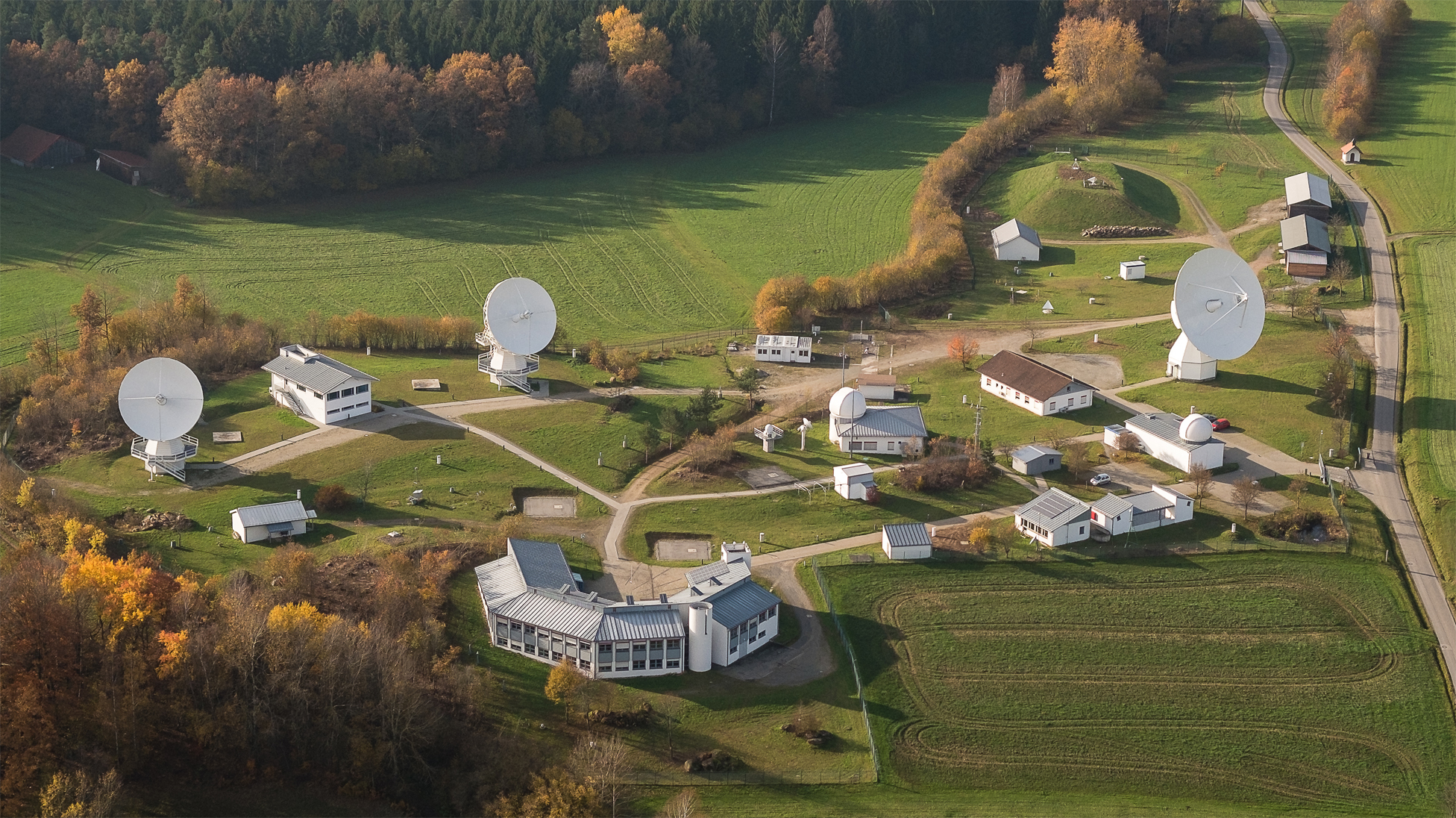
The goal of project P9 is a highly accurate and long-term stable realisation of the International Terrestrial Reference System (ITRS). It investigates new combination strategies using the common target and common clock at the Geodetic Observatory Wettzell (GOW), where VLBI, SLR, GNSS and DORIS are operated together.
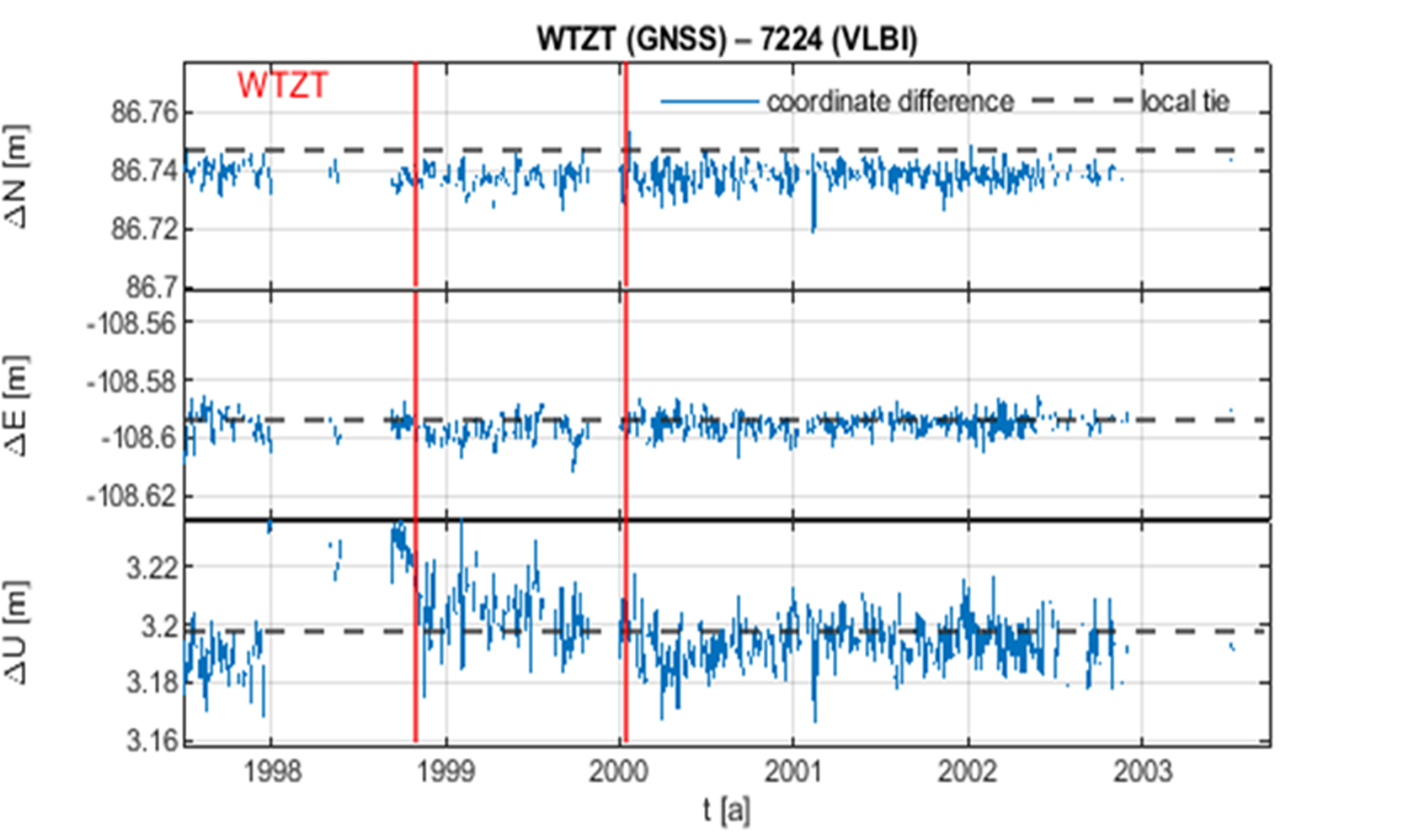
The project analyses long observation time series and calibration measurements to identify systematic differences within and between techniques. Real observations at Wettzell are complemented by global network simulations, including concepts for future satellites carrying several geodetic techniques. A further objective is to develop the equations needed to use observed inter-station time differences in geodetic combination.
Why it matters
How can shared time and geometric references improve the combination of different observing techniques?
Residual systematics and imperfect ties limit the accuracy and temporal stability of terrestrial reference frames. A common clock and target provide additional information alongside the station-coordinate links used in conventional combination.
Our approach
P9 combines real-data investigations with simulated observations and develops software that retains clock parameters for combination. Iteration with the calibration and technique-analysis projects helps distinguish physical station motion from instrumental effects. A mean stable reference clock reduces the influence of individual GNSS and VLBI reference clocks.
Key outcomes
- Established a database of discontinuities, periodic signals and velocity changes in Wettzell position time series from the homogeneous DTRF2020 processing.
- Generated seven-year GPS, SLR and VLBI simulation reference solutions for testing clock and common-target combination strategies.
- Showed in simulations that common-clock constraints reduce local coordinate–troposphere correlations, while slightly increasing some correlations with the wider network.
- Developed the mean stable reference clock approach and first GNSS–VLBI clock-parameter combinations. Local VLBI tests showed that sharing a maser is insufficient without controlling the instrumental signal-path delays.
Clock ties add information for reference-frame combination, but their benefit depends on reliable calibration. The simulations reveal both local gains and stronger network correlations that can transmit errors from shared-clock sites into the wider solution.
Publications:
- Seitz M., Blossfeld M., Angermann D., Glomsda M., Rudenko S., Zeitlhoefler J., Seitz F.: DTRF2020: ITRS 2020 realization of DGFI-TUM (data). Zenodo, 10.5281/zenodo.8220524, 2023
Presentations:
- Glaser S., Schreiner P., Raut S., Reinhold A., Brockmann JM. Next-generation GNSS and innovative combination strategies. Presented at: FGS Workshop; June 26, 2024; Bad Koetzting, Germany.
- Reinhold A., Glaser S., Kehm A., Seitz M. On simulations studies for novel combination strategies of space geodetic techniques. Presented at: FroGS; September 26, 2024; Stuttgart, Germany.
- Reinhold A., Glaser, S., and Seitz, M.: On simulation studies for novel combination strategies of space geodetic techniques, EGU General Assembly 2025, Vienna, Austria, 27 Apr-2 May 2025, EGU25-1646, https://doi.org/10.5194/egusphere-egu25-1646, 2025.
- Glaser S., Reinhold A., Klug J. and Seitz M.: On simulation studies of space geodetic techniques for innovative combination strategies, IAG Scientific Assembly 2025, Rimini, Italy, 1-5 September 2025