Project P2:
Accurate long distance optical time transfer from ground to ground via a satellite link
Project overview
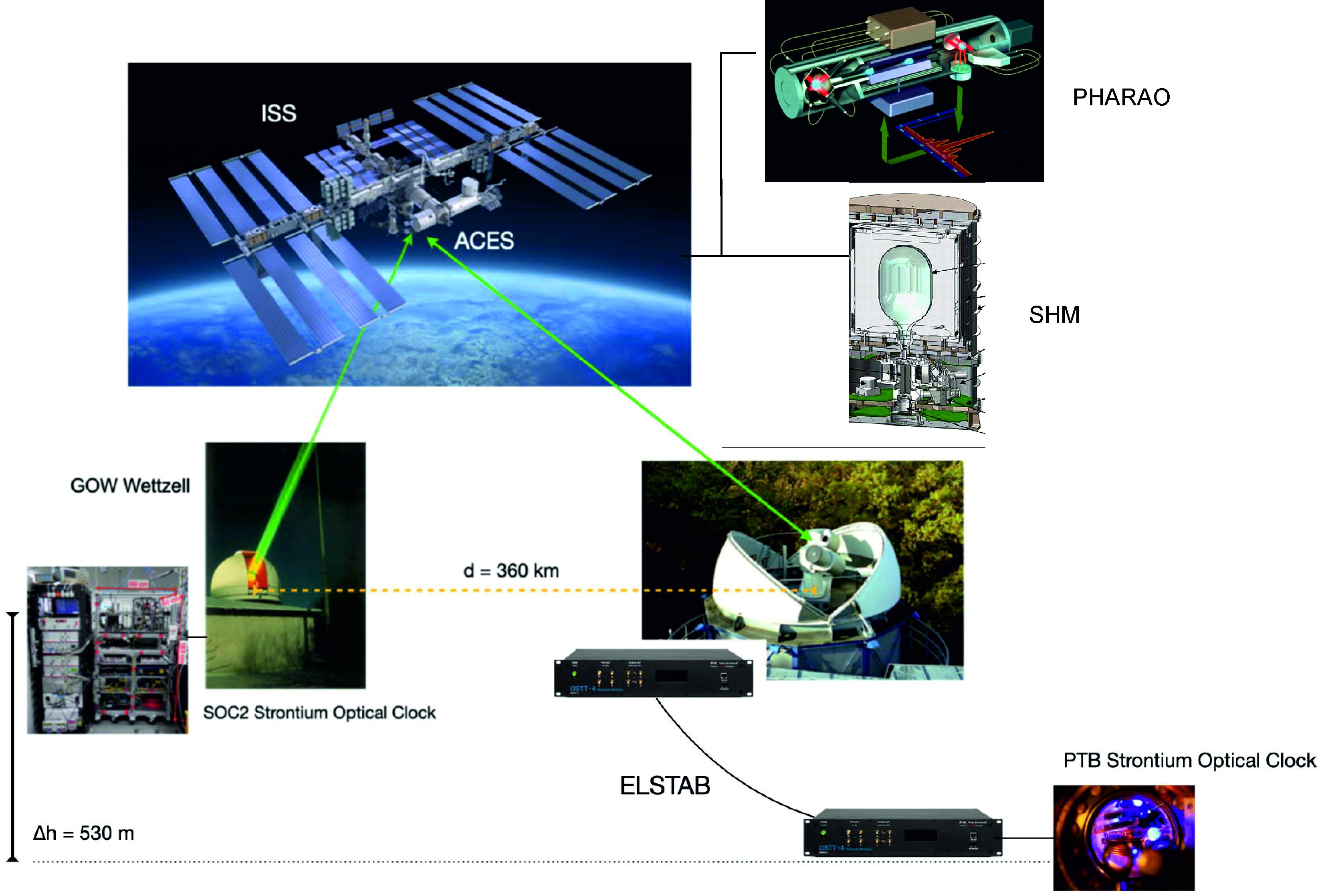
P2 investigates a novel geodetic tie derived from clocks and extends time coherence beyond a single observatory. The project connects remote ground clocks through optical time transfer via the Atomic Clock Ensemble in Space (ACES) on the International Space Station. It also develops the controlled clock comparisons needed to determine gravity-potential and physical-height differences between distant sites.
The experimental concept links Wettzell and Potsdam through European Laser Timing (ELT), while the ELSTAB fibre connection supplies the Potsdam laser-ranging station with the PTB reference from Braunschweig. The ACES microwave link provides an independent comparison. Together, these links support the calibration of system delays and the interpretation of relativistic clock-rate differences.
Why it matters
How can distant observatories compare their clocks with accurately controlled link delays?
A stable clock comparison is only as reliable as its signal path. Instrumental delays, the atmosphere and the satellite’s motion must be characterised so that link errors are separated from genuine differences between the clocks.
Our approach
The project combines satellite laser ranging with one-way laser timing and common-view clock comparisons. Delay-compensated local timing infrastructure connects the ground instruments to their clock references. Joint optical and microwave analysis investigates residual biases, while the common relativistic framework describes synchronisation between ground and space.
Key outcomes
- Connected Wettzell’s laser-ranging system to the MENLO timing infrastructure and adapted its observing, safety and calibration procedures for ELT.
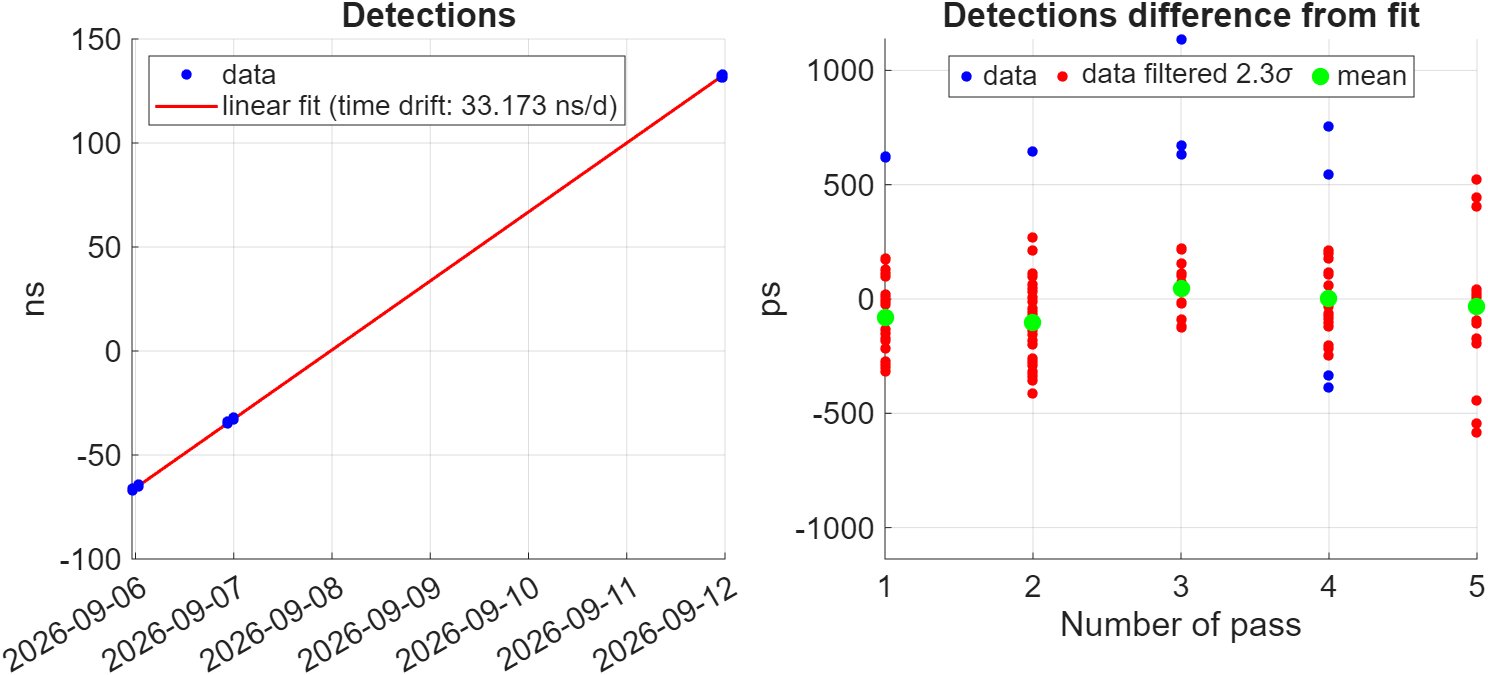
- Established routine tracking of the ACES reflector and achieved the first successful one-way ELT time transfer in September 2026.
- Improved the pre-launch event-timer calibration: the reported single-event comparison scatter fell from 141 ps to 97 ps in laboratory tests.
- Developed simulations showing how combined optical and microwave observations separate link biases from clock offsets, and why their relative weighting must include atmospheric fluctuations.
These developments provide the measurement and calibration basis for remote clock comparisons, chronometric height transfer and gravitational-redshift tests. The 97 ps timer scatter is a laboratory result, not the accuracy of an operational ground-to-ground link.
Contact
Project Information
Prof. Ulrich Schreiber
Dr. Sven Bauer
Dr. Thomas Klügel