Project P4:
General relativity and coherent time
Project overview
The project aims to advance our understanding of time in geodesy through a consistent theoretical description of clock comparisons. P4 provides the relativistic framework needed by the research unit to interpret coherent time, reference systems and synchronisation across terrestrial and space-based clock networks.
Its original objectives remain central: formulate time-comparison procedures analytically. Compare synchronisation methods using clocks on Earth and in space. Apply the resulting models to configurations involving Wettzell, Potsdam, Braunschweig and ACES. The project also examines how precise clock comparisons can support tests of general relativity and assesses possible applications of quantum synchronisation concepts.
Why it matters
How can clock differences caused by gravity be separated from motion and synchronisation effects?
Gravity, motion and Earth’s rotation affect measured clock rates and signal travel times. A consistent treatment is needed to interpret small timing differences as geodetic information or as tests of fundamental physics.
Our approach
An analytical top-down description establishes controlled benchmark cases in specified spacetimes. More realistic gravitational-field and signal-propagation models then connect those results with the experimental configurations. The framework covers fibre links, ground-to-space comparisons and the relativistic interpretation of physical heights.
Key outcomes
- Developed a general description and classification of synchronisation procedures for clock networks on the rotating Earth and in space.
- Derived the Sagnac contribution for the GFZ–PTB fibre link. The correction was implemented and validated in the link analysis.
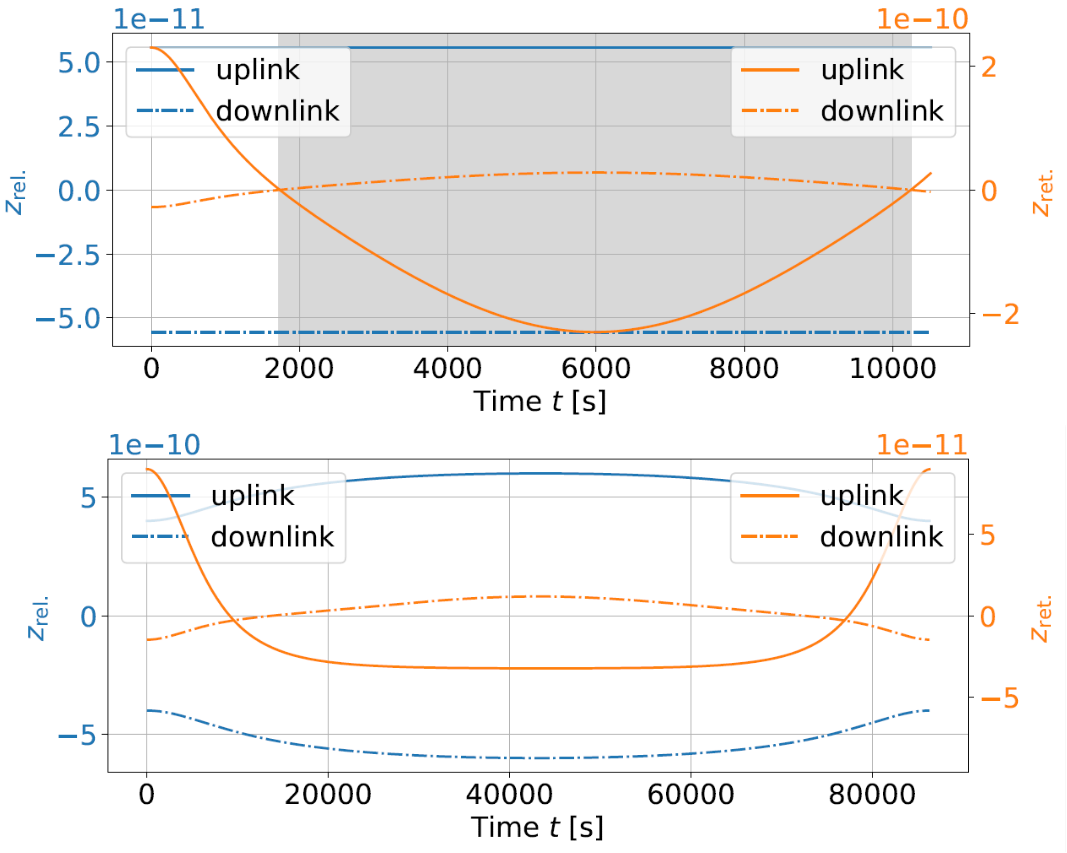
- Established that satellite motion during signal propagation must be treated consistently in satellite-based gravitational-redshift experiments.
- Connected clock comparisons to the relativistic definition of the geoid and assessed the potential and demanding precision requirements of clock-based gravity-field recovery.
The framework provides a common physical basis for the experimental projects. It supports reliable height determination and enables gravitational-redshift measurements to be interpreted consistently across different links and clock configurations.