Project P3:
Performance optimisation of the optical clock “SOC2”, installation and operation at Wettzell for geodesy and fundamental physics studies
Project overview
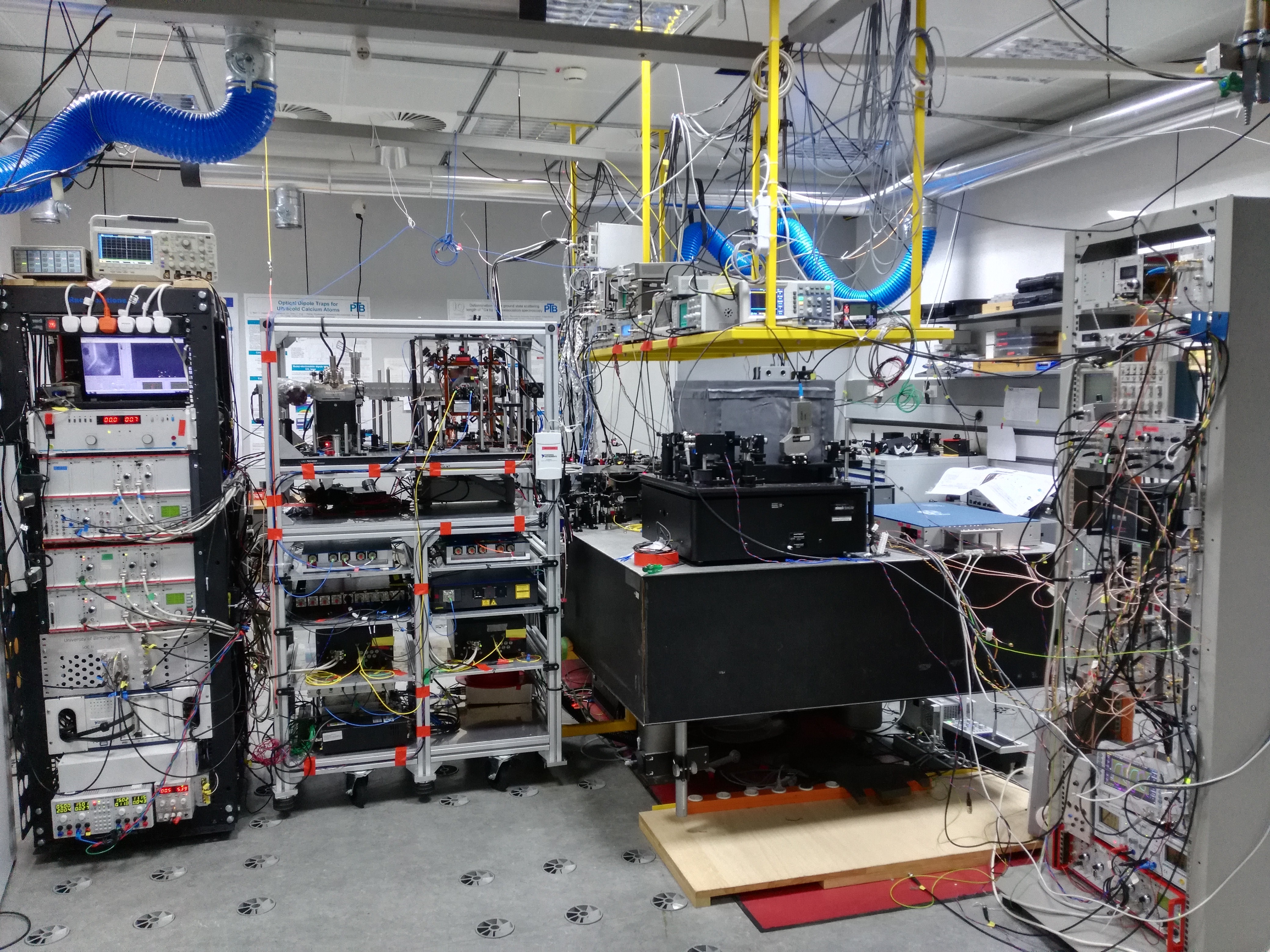
P3 focuses on the installation and operation of the transportable optical clock SOC2. Its role is to provide accurate timing signals at the Geodetic Observatory Wettzell (GOW) for comparisons with remote clocks through ACES. It can also serve as the local reference against which timing signals received from ACES are measured.
SOC2 is a strontium-88 optical lattice clock whose compact, modular design allows transport between laboratories and observatories. Its development builds on collaboration between Heinrich Heine University Düsseldorf, PTB and partners in Birmingham. Earlier characterisation at PTB used an ultra-stable clock laser and comparisons with a stationary optical clock. P3 advances this foundation towards reliable geodetic operation.
Why it matters
What can an accurately characterised optical clock add to a geodetic observatory?
Optical clocks connect precise timing with gravity: their rate differences contain information about gravity-potential differences. Their use at an observatory also provides an accurate frequency reference for time transfer and instrumental studies.
Our approach
The project improves SOC2’s performance, robustness and automation, characterises systematic frequency shifts, and develops transportable clock-laser systems. Comparisons with established optical clocks at PTB quantify the achieved performance before relocation and integration with Wettzell’s timing infrastructure.
Key outcomes
- Measured an instability of approximately 5.7e-16 in comparison with PTB’s Sr3 clock.
- Established a systematic uncertainty of 6.2e-17 at low atom number, and identified the shifts that limit further improvement.
- Measured the strontium-88/strontium-87 isotope shift and direct frequency ratios to indium-ion and ytterbium-ion clocks.
- Developed transportable clock-laser systems and advanced the preparations for relocating SOC2 and integrating it with Wettzell’s timing infrastructure.
SOC2 brings optical-clock metrology into the measurement environment of a fundamental geodetic observatory. The characterised clock supports the planned time-transfer, height and fundamental-physics experiments. Gull deployment at Wettzell remains is planned for the end of 2026.