Project P6:
Time as observable in integrated ground and space-based GNSS analysis
Project overview
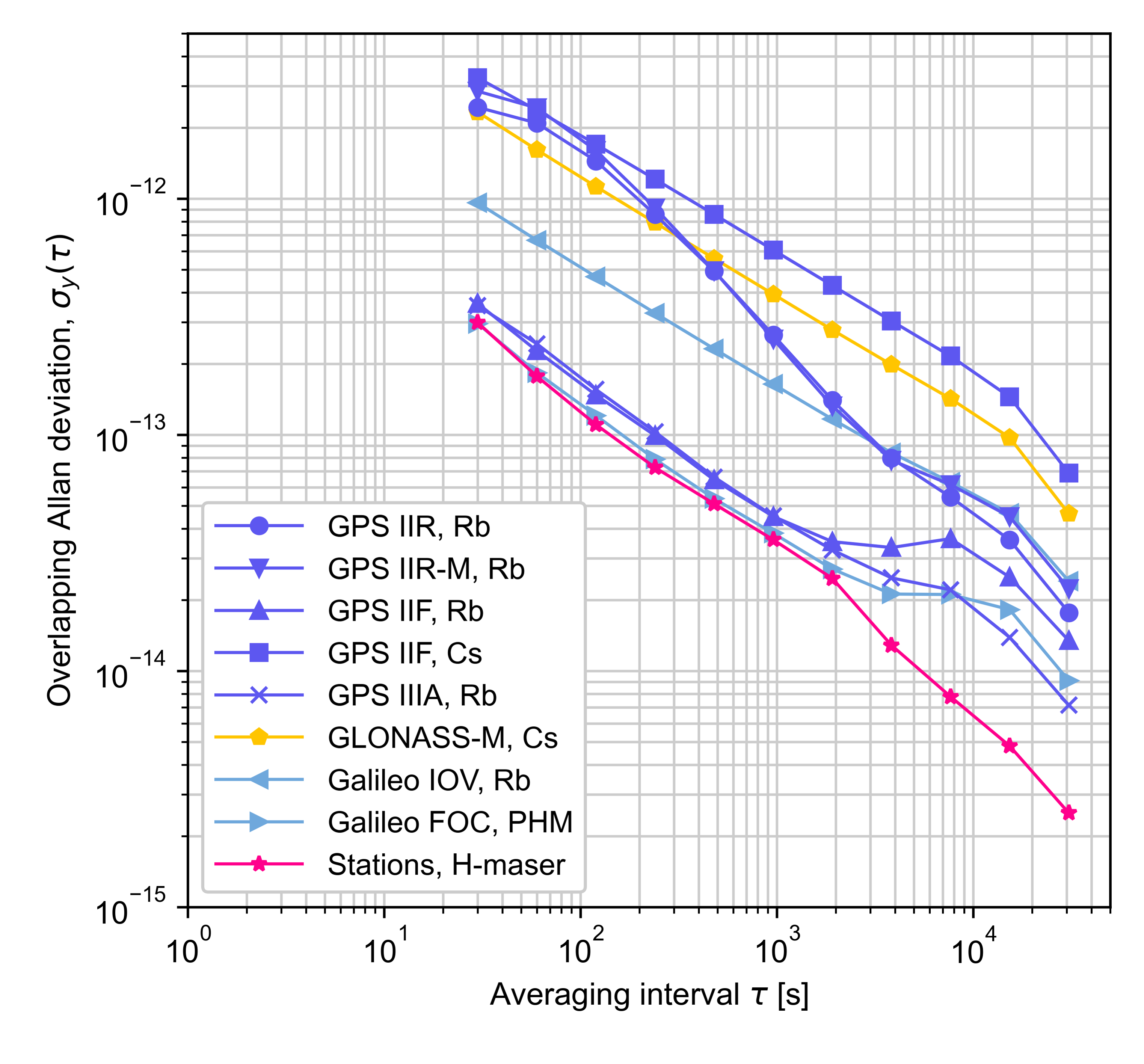
The goal of P6 is to integrate data from ultra-stable clocks on ground and in space into GNSS analysis, together with information from precise time and frequency links. The project assesses their contribution to global geodetic products and develops methods that make clock stability useful within the analysis.
At Wettzell, closure experiments investigate GNSS receivers connected to a common clock over short baselines. The regional links between Wettzell, Potsdam and PTB provide the wider context for common-clock studies. In parallel, the project investigates ground- and satellite-clock modelling for improved orbit determination, reduced parameter correlations and global network analysis, considering both deterministic behaviour and stochastic variations.

Why it matters
How can knowledge of clock behaviour strengthen GNSS-derived coordinates and other geodetic products?
Independent clock estimates at every epoch are strongly coupled with station height and atmospheric delay. Stable clocks provide additional information that can reduce those correlations, provided the remaining instrumental and modelling effects are controlled.
Our approach
Clock-stability analyses guide flexible clock models and common-clock constraints in the Bernese GNSS Software. Local and regional observations test the methods, while global real-data analyses and simulations assess their benefits and limitations for wider GNSS networks.
Key outcomes
- Identified about 60 of 80 investigated hydrogen-maser stations with average daily clock scatter below 75 ps, supporting clock modelling over multi-hour intervals.
- In a month-long kinematic PPP analysis of 56 stations, reduced median height scatter by 1.6–3.0 mm, or about 10–20%. Favourable stations gained up to 45%, while some deteriorated when residual systematics were not captured.
- Demonstrated regional clock agreement through the PTB–GFZ fibre link at about 20 ps daily standard deviation and 15 ps time deviation after one day.
- With common-clock constraints, reduced GNSS tropospheric-delay RMSE against a water-vapour radiometer from 2.89 mm to 2.40 mm, approximately 17%.
The results show how time can contribute directly to GNSS positioning and atmospheric estimation. The gains depend on clock quality and the control of residual hardware and modelling effects, making calibration and appropriate model selection essential.
Publications
Widczisk, JS, Männel, B and Wickert, J (2026): Investigations into highly stable GNSS ground and space clocks using a network of globally distributed H-maser stations. GPS Solut 30, 21. https://doi.org/10.1007/s10291-025-01986-7
Presentations
Widczisk, J. S., Männel, B., Wickert, J. (2024): Investigations into GNSS clock biases in a global network of IGS H-Maser stations - Abstracts, EGU General Assembly 2024 (Vienna, Austria and Online 2024). https://doi.org/10.5194/egusphere-egu24-6472
Widczisk, J. S., Männel, B., Wickert, J. (2024): Investigations and approaches for modeling GNSS clocks in a global network - Abstracts, 9th International Colloquium on Scientific and Fundamental Aspects of GNSS (Wroclaw, Poland 2024).
Widczisk, J. S., Männel, B., Wickert, J. (2025): Modeling of highly stable GNSS ground and space clocks using piece-wise linear representations - Abstracts, EGU General Assembly 2025 (Vienna, Austria and Online 2025). https://doi.org/10.5194/egusphere-egu25-2545
Widczisk, J. S., Männel, B., Wickert, J. (2025): Modeling of highly stable GNSS ground and space clocks using piece-wise linear representations - Abstract Book, IAG Scientific Assembly 2025 (Rimini, Italy 2025).
Widczisk, J. S., Männel, B., Wickert, J. (2026): Piece-wise linear clock modeling for highly stable IGS H-maser stations in Precise Point Positioning - Abstracts, EGU General Assembly 2026 (Vienna, Austria and Online 2026). https://doi.org/10.5194/egusphere-egu26-3083