Project P1:
Galileo pseudolite calibration target used to consolidate time between space geodetic techniques
Project overview
P1 extends local time coherence at the Geodetic Observatory Wettzell (GOW) to GNSS. The project develops a Galileo pseudolite calibration target that uses the clock signal from an actively delay-compensated optical fibre link to transmit an external time reference over the air. This connects GNSS to the common timing infrastructure used by the other space-geodetic instruments.
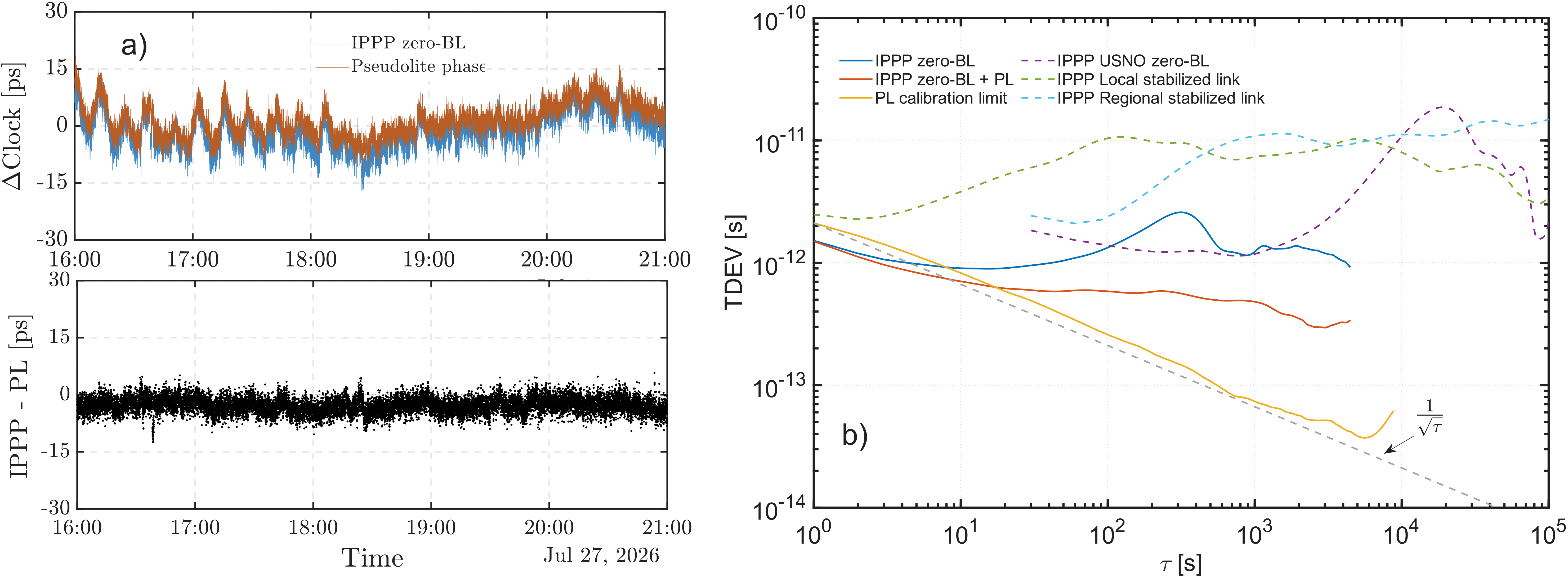
The calibration addresses the difference between the geometrically defined antenna reference point and the effective measurement reference, which also depends on the antenna phase centre and hardware delays. A controlled phase relationship between the local clock and the calibration signal provides a way to investigate variable delays throughout the GNSS receiver chain.
Why it matters
How can GNSS receivers share a time reference without hiding their own instrumental delays?
Temperature changes in antennas, cables, and receiver electronics can alter measured phases even when the external clock is stable. Measuring these variations is necessary for accurate clock comparisons and a consistent connection between GNSS, VLBI and SLR.
Our approach
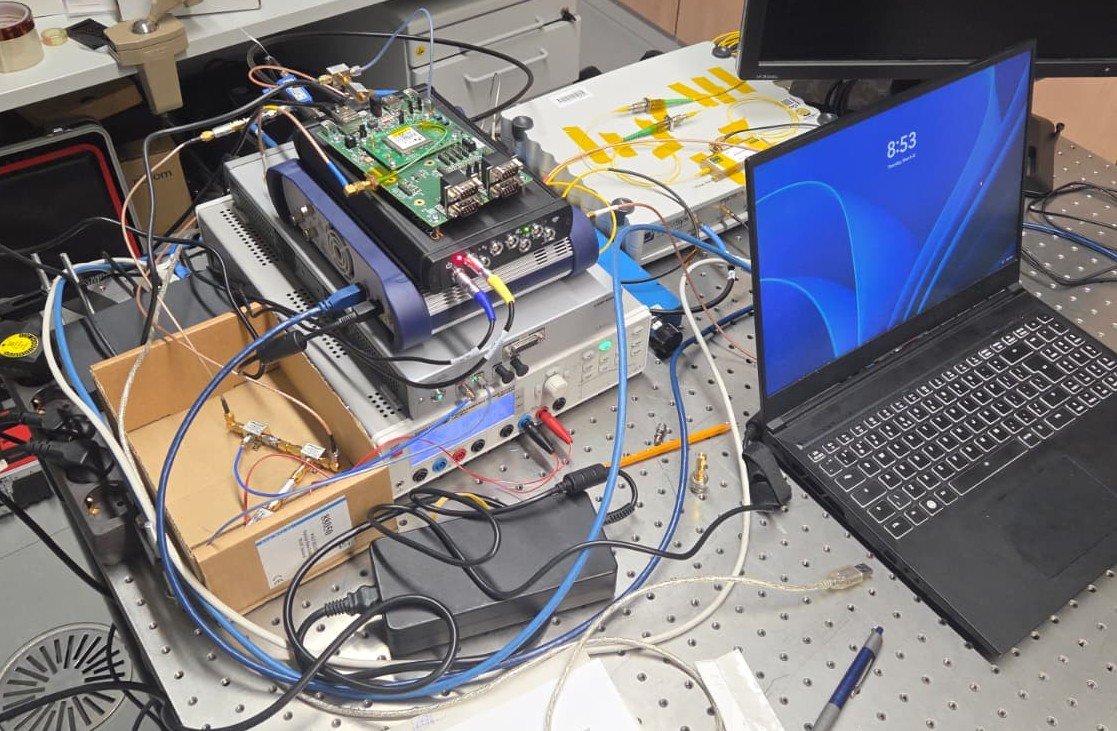
A software-defined radio generates a Galileo-like signal that geodetic receivers track alongside the satellite signals. Optical synchronisation and active feedback are designed to control the transmitter’s own delays, so that receiver-induced phase and timing variations can be identified. P6 provides the associated GNSS processing and analysis.
Key outcomes
- Built a software-defined-radio prototype whose single-frequency Galileo-like signal is reliably tracked by a commercial geodetic GNSS receiver.
- Extracted carrier-phase and code observations and demonstrated sustained carrier-phase tracking over long intervals.
- Developed the optical synchronisation and feedback-calibration concept needed to stabilise the transmitted code and carrier phase.
The demonstrator establishes the hardware and signal-processing chain for this new calibration approach. Completing and validating end-to-end receiver-chain calibration is the next step towards traceable GNSS clock ties.
Publications:
Kimmer M., Pany T., Kodet J. "Optical Two-Way Time and Frequency Distribution for Space Geodesy Applications". Presented at: European Frequency and Time Forum (EFTF), April 2026, Noordwijk, Netherlands.
Kodet J., Kimmer M., Wang Z., Pany T. "Towards Clock Ties in GNSS: A Real-Time Phase Calibrator for Receiver Instability Mitigation". Presented at: EGU General Assembly, May 2026, Vienna, Austria. https://doi.org/10.5194/egusphere-egu26-16284
Kimmer M., Kodet J., Pany T. "Optically Synchronized GNSS Pseudolite for Precise Time and Phase Calibration". Submitted for publication to the IEEE Navigation Conference (NAVICON), December 2026, Munich, Germany
Contact
Project Information
Prof. Thomas Pany